
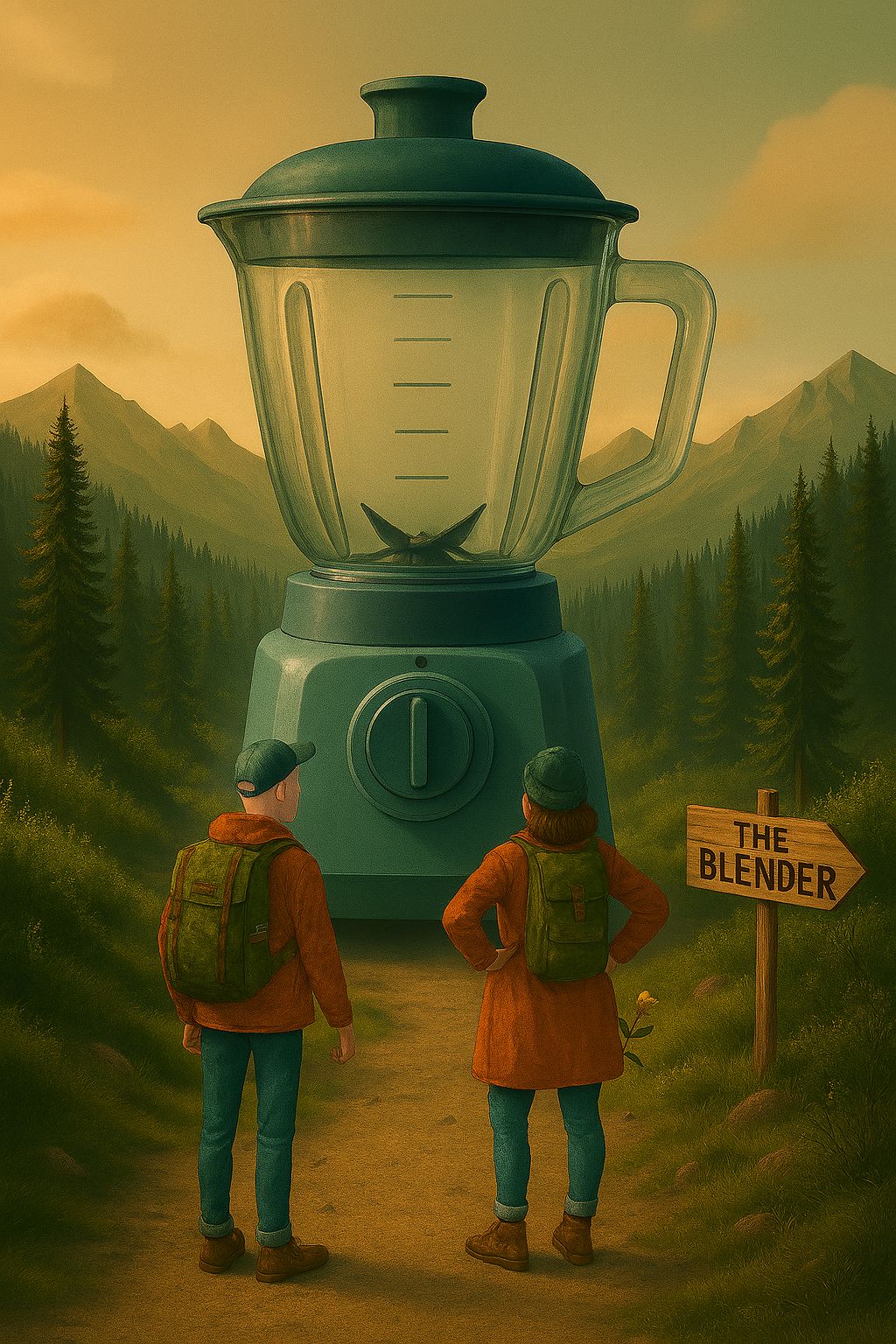
I took a sabbatical from Microsoft in late 2024. It’s a nice perk offered to long-term employees like me who are ready to step away from the office and find out how many consecutive days they can spend providing helpful process improvements at home before their spouse murders them.
It’s not as many as you’d hope.
Since I didn’t want to spend the rest of my life working and my wife didn’t want to spend hers in prison, we decided to use the opportunity to train for my eventual retirement.
Mostly, things went pretty well. We worked through a backlog of household repairs, ate more lunches together, and walked the dog. A lot. We ventured out on road trips and spent some extended time in Hawaii. We snorkeled, hiked, and biked — sometimes all in the same day. And after 32 years of marriage, we finally agreed that Christmas lights should always come down before New Year’s and not “when the spirit moves us.”
Our only real skirmish – and I probably shouldn’t even mention it – centered around a blender. Or what the Netflix documentary might refer to as Exhibit A.
It started with a simple misunderstanding. We were a few minutes into an early morning hike and Tamie was unusually quiet. Since I’d picked the day’s route, I figured she was out of breath and possibly a little upset about the trail conditions.
“Don’t worry,” I assured her. “It flattens out after a couple miles. Just keep your head down so you don’t snag one of your eyeballs on a blackberry vine.”
“It’s not that,” she said, stepping through the branches of a freshly fallen tree. “I was thinking about the blender.”
I paused, mentally scanning the route ahead for some dubious feature nicknamed “The Blender.” I didn’t remember it from the map. “Where’s that one at?” I asked.
“At home. In our kitchen. Where you left it.”
“Oh, that blender,” I said, a little relieved. I wasn’t sure Tamie was ready to tackle anything that merited capital letters. “Do you want to make a smoothie when we finish? We could stop by the market on the way home and grab some fruit—”
“We should’ve actually agreed before you bought it.” She wasn’t even slightly winded. Nor did she seem bothered by the so-called “trail.”
Uh oh.
I silently reviewed the purchase and how I thought things had gone:
- Tamie and I talked about adding some healthier options to our diet, including fresh smoothies.
- After researching ingredients, recipes, and equipment, I concluded our current blender was far too underpowered and dull to handle modern vegetables.
- I shared this data with Tamie and told her I’d wait for a sale.
- Costco sent me a promo email two hours later.
It seemed I’d skipped a key conversation somewhere between getting that email and unboxing the blender. It was my mistake, and I planned to apologize as soon as I caught up. Her pace over the last few hundred yards had noticeably quickened.
“Hey,” I said, as she began ascending the first of many steep, wet, rooty pitches. “I’m sorry I didn’t tell you—”
“That blender is massive. And heavy. And loud. I feel like I need a safety helmet to operate it. Couldn’t you have gotten a smaller version?” Her voice faded as she crested the top. It was like watching a nature documentary about a mountain goat. A slightly agitated one, but still.
I bent over, hands on knees, to contemplate the life decisions that had led me there. I could only think of two. One, I should’ve learned to read topographic maps, and two, I should’ve shopped for a cheaper blender. Clearly, she was upset about the cost.
“And I’m not upset about the cost,” Tamie said, stepping back to the edge of what I’d later dub The Scrambler. “You knew we didn’t have the countertop space for something like that!”
I did not. In fact, countertop space hadn’t crossed my mind. Ever. And even if it had, I certainly wouldn’t have imagined arguing about it in a forest with my wife, especially while she held the higher ground.
“It was already cluttered,” she continued. “Even before you bought that coffee pot.”
“You mean espresso machine?” I corrected, then immediately wished I hadn’t. It had been a source of contention all summer. Instead of paying Starbucks $8 per latte, I’d decided to invest in my own machine. Of course, I also needed the crucial stainless‑steel accessories and a monthly subscription for gourmet beans. That brought my cost per drink to $35. But then I generated some mathematical models that proved if I lived long enough—and that was a very big IF—Tamie would still never forgive me. She hates all things coffee: the taste, the smell, the caffeine. And, apparently, the space it occupied.
“My point is,” she said, “I don’t like appliances left out for no reason. So please put the blender away when you’re not using it.”
I slogged up the final section of The Scrambler and stepped next to her. “Every . . . single . . . time?” I asked. The pauses weren’t for dramatic effect; they were for oxygen.
“Yes. Every . . . single . . . time,” she said, dramatically.
Digging the blender in and out of the cupboard was a lot to ask. Realistically, I’d never go to the extra trouble. It would be much easier to abandon my health goals and die of scurvy.
I sighed. “Why do you even need all that countertop space?”
“So there’s always room for me to make your favorite peanut butter cookies. And for you to leave me bouquets of freshly cut flowers.” She reached over and plucked a blackberry thorn from my cheek, then smiled. “You can start with this.”
I smiled back and bowed, conceding victory. It is, after all, hard to argue against love. And sure, there were a few details left to work out, like which cupboards were available and if our kitchen table could double as a remote countertop, but it was nice to just stand beside her and breathe. If only for a moment.
“You ready?” I asked. “Looks like you’ve recovered.”
“Yup. And it looks like you’ve stopped bleeding,” she said, pointing at my face.
I winced, remembering how many days it had been since she’d last said those words.
It’s not as many as you’d hope.

Loved this. Hope all is agreed with the Blender now!
Gwen.
LikeLiked by 2 people
Yes, it is currently tucked neatly away in its cupboard. 🙂
LikeLiked by 1 person
Ouch. Seems like you were dropped into the middle of a marital minefield where every step is frought with peril 😂👏
LikeLiked by 1 person
And it’s always so hard to fight when you have no idea what it’s about!
LikeLiked by 1 person